Why a Warehouse Overhead Door Drifts Down and What to Check First
The short version
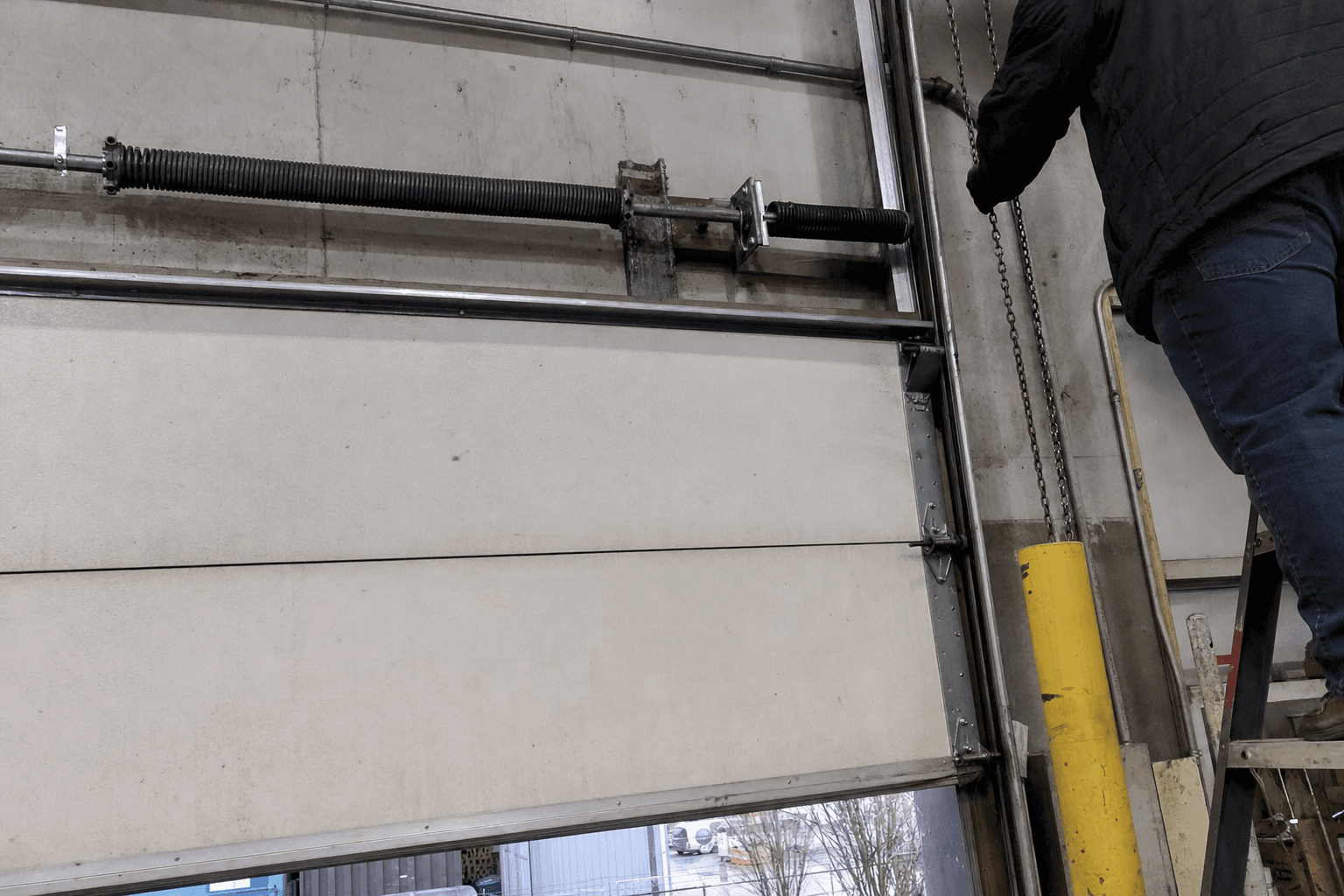
A warehouse overhead door that drifts down is almost always out of balance. The usual causes are a spring that has lost tension, a cable off its drum, or extra weight on the door. A trained person can check balance with the operator disconnected. Do not adjust springs or cables yourself. Those parts hold enough force to cause serious injury.
- A drifting door usually means the spring balance has been lost, not that the operator has failed.
- Check balance only with the door closed and the operator disconnected, and stay clear of the door's path.
- Never adjust springs, cables or drums yourself. They are under high tension.
- Cold Langley nights stress springs and stiffen rollers, so drift often shows up in late October.
- Most spring, cable and roller repairs take a few hours, and a quote comes before work starts.
What door drift means
A door that drifts down won't stay open for loading. You raise it, walk away, and it creeps toward the floor. Or it stays up for a while and then settles.
On a large sectional door, the springs carry nearly all of the door's weight. The operator is there to move the door, not to hold it. When the springs stop doing their job, the operator ends up holding a load it was never sized for. That is when you see drift, straining and noise.
If you manage a warehouse in Willowbrook, Fernridge or Aldergrove, you may see this first on the doors that cycle the most. It tends to show up as nights get colder in late October.
Common causes of a drifting door
These are the usual causes, roughly from most to least common on busy doors.
- Spring has lost tension. High-cycle springs wear with use. A spring can lose torque well before it breaks, and the door gets heavier on the operator.
- Spring is broken. A broken spring often leaves the door stuck half open or very heavy to lift.
- Cable has slipped or frayed. If a cable comes off its drum or is damaged, the door hangs unevenly and can drift or tilt.
- Added weight. Signage, insulation, windows or a repaired section can change the door's weight. The springs were set for the old weight.
- Bent sections or track. A door that has been clipped by a forklift or truck can bind on one side and sit crooked.
- Worn rollers and hinges. On a door that cycles all shift, worn parts add drag and hide the real balance problem.
- Operator limits or brake. Less common, but a worn brake or poorly set limits can let a motor operator creep.
A safe balance check
A balance check tells you whether the problem is the springs or the operator. It should be done by a trained maintenance person, not by someone trying it for the first time.
Before you start
Close the door fully. Keep people and equipment out of the door's path. Look at the cables, drums, rollers and track for obvious damage. If you see a frayed cable, a cable off a drum, a gap in the spring, or a crooked door, stop. Tag the door out of service.
The check
Disconnect the operator using the manufacturer's procedure. Lift the door by hand to about halfway. A balanced door stays where you leave it, or moves only slightly. If it falls, the springs are weak or broken. If it shoots upward, the tension is too high or the door is lighter than the springs expect.
A door that is very hard to lift by hand is a sign of a broken spring. Don't force it.
What not to do
Don't wind, loosen or adjust springs. Don't touch the cables or drums while the door is under load. These parts hold a lot of stored force, and mistakes cause serious injuries.
Don't keep running a drifting door on the operator. The motor, gearbox and drive parts take the strain. A repair that would have been a spring job can turn into a spring and operator job.
Don't prop the door open with a pallet or a forklift tine. If the door drops, it can damage product, equipment and people.
Cold weather makes drift worse
Langley is further inland than the coastal cities. Winter nights are colder, and frost is more common. Cold stiffens grease on rollers and hinges. It also stresses springs that are already near the end of their cycle life.
A bottom seal that freezes to the floor can also mimic drift problems. The door seems heavy or stuck, and the operator strains against the ice. Clear the seal and check whether the door then moves freely before blaming the springs.
Older doors on units around Walnut Grove and Langley City Centre often still have their original hardware. If a door has cycled for years without a spring replacement, it is a good candidate for a check before the cold sets in.
What the repair usually involves
Most spring, cable and roller repairs take a few hours. If several sections or full track runs have to be replaced after a strike, plan for a day or more.
We give you a quote before any work starts. We plan the work around your shifts and shipping windows so that only one door is out of service at a time.
After the repair, the door should stay where you leave it at any height. The operator should move it smoothly without straining.
Keeping a record
If the same door drifts again, you want to know when its springs were last replaced and how many cycles it sees. A short written record for each door makes that easy. It also helps you decide whether to replace springs on neighbouring doors at the same time.
When to call a professional
Call a technician if the door drifts, hangs crooked, is hard to lift by hand, or has a visible gap in a spring or a damaged cable. Call too if the operator strains or trips. Tag the door out of use until it is checked. If your balance check shows the door is fine and the problem is only the operator, a technician can confirm that quickly and save you from replacing parts you don't need.